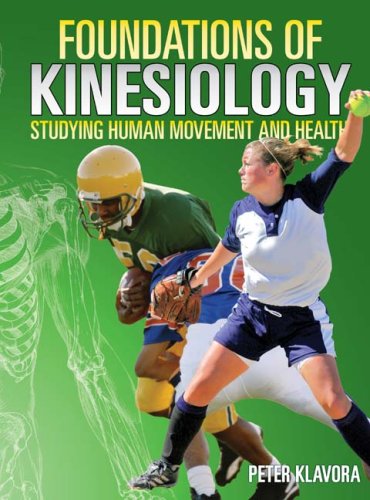
Lưu ý: Hình bìa chỉ mang tính minh họa — không phải ảnh sách thực tế. Nội dung và bản quyền sách được đảm bảo chính hãng từ nhà xuất bản. Chợ Sách chỉ cam kết sách do người bán cung cấp là sách chính hãng; khiếu nại về bìa khác hình minh họa sẽ được xem xét từng trường hợp.
Foundations of Kinesiology: Studying Human Movement and Health
Tác giả: Peter Klavora
NXB: Sport Book Pub
Chi tiết sản phẩm
- #5,554,928 in Books
- #4,797 in Sports Training
- #33,911 in Instruction Methods
- #40,490 in Education
Về tác giả — Peter Klavora
Follow authors to get new release updates, plus improved recommendations.
Đánh giá từ chuyên gia
From the PublisherImagine that you are sitting at home on a Saturday night and have just tuned in to the basketball game. What do you see? Players running back and forth at break-neck speed? Fancy footwork and a great move to elude a defensive player? A three-point shot that drops through the net with an audible "swish"? Perhaps you even notice the crowd cheering, the head coach appearing just a little more at ease, or the athletes offering encouragement to their teammates. The more you watch, the more you appreciate the remarkable amount of action in an average basketball game. While that may be obvious, something even more remarkable is perhaps less obvious. Although records, awards, and titles may be the simple goals of any basketball player, what goes on inside an athlete such as LeBron James is much more complex and fascinating than meets the eye. The mark of any champion can be found in his or her perseverance and dedication to training for excellence. As a young child, James amused himself for hours at a time with a miniature ball and hoop. But how did this very basic activity contribute to his outstanding ability on the court? How did simple childhood play maintain and improve his skill level throughout the crucial stages of growth and development? Further, what is the best way to train? Would James be the success he is today if he had used a different training regimen? Another quality that champion athletes possess is the ability to overcome adversity. After sustaining a serious knee injury in 2002, soccer star Mia Hamm faced surgery, months of painful rehabilitation, and the uncertainty of making a complete recovery. Two years later, Hamm led the U.S. women's soccer team to the gold medal at the Athens Olympics, proving to the world that hard work and determination (and a lot of skill) can pay off. What was going on within Hamm's body as she gracefully powered her way down the soccer field? How did she ensure that she had enough energy to last the entire game? Are we all capable of that level of endurance, or did Hamm possess a unique supernatural trait? And where did she find the energy to pace herself for a 90-minute match? This raises a range of other questions - where did this energy come from? Was it derived from the food she ate? How did her body store and allocate energy to support long, tiring matches and short sprints to the goal that require quick and powerful bursts of energy? Successful performances also require some degree of muscular training. What muscles did James develop to make him a fast and agile runner? Do these muscles bear unusually large amounts of stress? Basketball players are particularly prone to ankle injuries; what is it about the sport that makes its athletes so vulnerable? Do drugs or treatments exist that may prevent such mishaps? And while we are on the topic of drugs, how do steroids and other substances influence athletic performance? Does an athlete's requirements for training change with drug use? Maybe an athlete's ability has little to do with years of practice. Certain laws of physics can be applied to sport, so it may be that Hamm knew something about biomechanics that gave her a competitive advantage. Maybe she understood the proper technique to maximize running efficiency while minimizing fatigue. After all, principles of biomechanics have been used by sport scientists for many years in sports such as gymnastics, pole vaulting, and cycling. In a league full of talented defensive players, how does James manage to score so many points? Was he lucky enough to be born with remarkable shooting accuracy, or did he have to develop this ability? As an outstanding individual player, James's talents are not limited to his phenomenal physical skills: he also has exceptional vision. His ability to read the play and anticipate how it will unfold helps him unleash his trademark passes. What goes on in his mind to make him always conscious of every player on the court? Does James ever get nervous or lose his focus? There must be days when athletes just don't feel they can perform up to their potential. Every athlete is prone to such doubts over a career. But how was Hamm able to stay motivated to train and return to form after a serious injury? What does it take to remain competitive year after year with the same focus and drive? How does James rise to the occasion in a big game while others wilt under the pressure? With the salaries that many professionals are bringing in these days, the motivation to perform might be found in their back pockets. When you review the number of games a basketball player plays in a season, year after year, with different teams and different teammates, the question arises: How do they stay "up" for every game? Does James ever relax and perform only marginally? Did Hamm have physiological characteristics that allowed her to endure more pain than the average person? Did her experience and years of training help her overcome an injury that could have ended her career? What made the difference for these two athletes? Their personality characteristics certainly helped both rise to stardom in their respective sports - time after time they excelled against the best competitors the world could offer. What made the difference? Was it because they could afford the best coaches, trainers, and equipment? This brings up the issue of money. Where do astronomical sums of cash fit into the broader picture of sport? Do large salaries make players excessively greedy, to the point that they are willing to strike, risking the loss of an entire season of play? Does this change how the fans perceive players? Does this aspect detract from the beauty and tradition of sport by placing it in the hands of capitalism and big business? And speaking of fans, how do we, as spectators, view sport, and how does it affect our lives? Every American has certainly had some degree of exposure to basketball, soccer, and other sports. Increasingly, as women and minorities seek the opportunity to play, and as citizens' coalitions band together to prevent televised violence, sport has become a focus of political and social issues. As you can see, a single glimpse into the world of sport can generate discussion over a variety of subjects. And that, specifically, is the purpose of this textbook. The chapters that follow expose you to a variety of perspectives associated with physical and health education. You are most likely familiar with the sporting and physical activity aspects of these courses; however, this course is designed to provide a unique opportunity for students to apply sports-related ideas to associated areas including medicine, sociology, physics, and business. With the expansion of your knowledge in this area, you should be motivated to strive for a higher quality of life through your own level of physical fitness. Rather than simply tell you that healthy living is desirable, we will show you why. For this reason, the following chapters are structured so that you have the opportunity to apply the knowledge you learn.
From the AuthorThe more you watch, the more you appreciate the remarkable amount of action in an average basketball game. While that may be obvious, something even more remarkable is perhaps less obvious. Although records, awards, and titles may be the simple goals of any basketball player, what goes on inside an athlete such as LeBron James is much more complex and fascinating than meets the eye.
Mô tả nội dung sách Foundations of Kinesiology: Studying Human Movement and Health - Peter Klavora
Thông tin sách: Foundations of Kinesiology: Studying Human Movement and Health (Hardcover, 578 trang) – Sport Book Pub, 2007. Ngôn ngữ: Tiếng Anh.
FOUNDATIONS OF KINESIOLOGY is a textbook designed for senior high school and introductory college and university programs in kinesiology, physical education, and exercise science. The book explores the multifaceted world of kinesiology: the study of human movement and the body’s response to exercise. It examines the systems, factors, and principles involved in human development within the context of society. Relevant fields in the study of kinesiology (23 chapters) include anatomy, physiology, biomechanics, nutrition, motor learning and control, and sport psychology, sociology, and philosophy. The relevant career options available to students in the field are also examined.Giá bán
3.254.000 ₫
Đánh giá sản phẩm(38)
Sách cùng tác giả Peter Klavora
Xem tất cả →
Sách cùng thể loại
Xem tất cả → 0
0People, Places, and Mathematics: A Memoir (Springer Biographies)
Thomas Ward
Liên hệ
0 0
0Rural Education Research in the United States: State of the Science and Emerging Directions
Gwen C. Nugent, Gina M. Kunz, Susan M. Sheridan, Todd A. Glover, Lisa L. Knoche
5.900.000 ₫
 0
0Positive Child Guidance (MindTap Course List)
Darla Miller
1.458.000 ₫
 0
0The Art of Coaching Workbook: Tools to Make Every Conversation Count
Elena Aguilar, Lori Cohen, Laurelin Whitfield
734.000 ₫
 0
0High School Geometry Unlocked: Your Key to Mastering Geometry (High School Subject Review)
The Princeton Review, Heidi Torres
528.000 ₫
 0
0Reading Like a Historian: Teaching Literacy in Middle and High School History Classrooms―Aligned with Common Core State Standards
Sam Wineburg, Daisy Martin, Chauncey Monte-Sano
1.055.000 ₫
 0
0The Writing Revolution 2.0: A Guide to Advancing Thinking Through Writing in All Subjects and Grades
Judith C. Hochman, Natalie Wexler, Kathleen Maloney, Doug Lemov
647.000 ₫
 0
0Learn Chords on Guitar: Volume I - Major Harmony 3 Note Chords
Mr Philippe Merlin
Liên hệ
0 0
0The Tragic Protest
Zygmunt Adamczewski
Liên hệ
0 0
0Re-Imagining Curricula in Global Times: A Music Education Perspective (Global Perspectives on Adolescence and Education, 4)
Jennifer M. Mellizo
5.244.000 ₫
 0
0The Early Intervention Teaming Handbook: The Primary Service Provider Approach
Dr. M'Lisa L. Shelden PT Ph.D., Dr. Dathan D. Rush Ed.D. CCC-SLP, Dr. R.A. McWilliam Ph.D.
981.000 ₫
 0
0History through Narratives of Education in Africa: Social Histories in Times of Colonization and Post Independence (1920s - 1970s) (Africa-Europe Group for Interdisciplinary Studies, 33)
Ellen Vea Rosnes, Pierre Giudi, Jean-Luc Martineau
Liên hệ
0