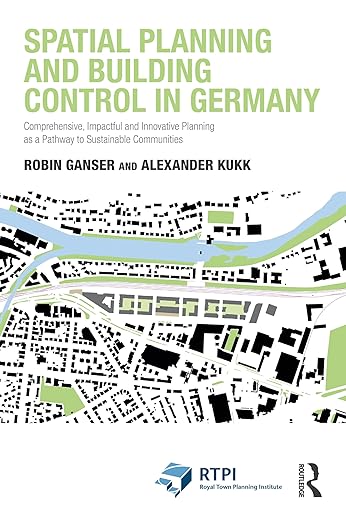
Lưu ý: Hình bìa chỉ mang tính minh họa — không phải ảnh sách thực tế. Nội dung và bản quyền sách được đảm bảo chính hãng từ nhà xuất bản. Chợ Sách chỉ cam kết sách do người bán cung cấp là sách chính hãng; khiếu nại về bìa khác hình minh họa sẽ được xem xét từng trường hợp.
Spatial Planning and Building Control in Germany: Comprehensive, Impactful and Innovative Planning as a Pathway to Sustainable Communities (RTPI Library Series)
Tác giả: Robin Ganser, Alexander Kukk
NXB: Routledge
Chi tiết sản phẩm
Về tác giả — Robin Ganser
Follow authors to get new release updates, plus improved recommendations.
Đánh giá từ chuyên gia
Review“Spatial Planning and Building Control in Germany is a superb resource for better understanding planning policy, the legal framework for spatial planning, and decision-making processes for development at the local level in Germany. There are fascinating discussions about urban reinvestment (redevelopment), property rights, and public-private partnership initiatives. Particularly noteworthy are the many examples of best practices from a number of German cities – including large and medium-size cities, as well as smaller municipalities. In many ways, this book offers a very useful and complete standard for understanding local government planning. It also provides a comprehensive look at 21st century urban planning with applications to other nations and the challenges their local communities face."Dr. Rocky Piro, FAICP, retired planner and professor, former Director, Colorado Center for Sustainable Urbanism"Since the earliest days of modern planning, Germany has been at the international forefront of planning thought and practice. Today, we in the English-speaking world admire the quality of the results of German planning. Yet we know surprisingly little about how it operates. This concise and clearly written book therefore fills an important gap. The authors discuss the main concepts and models shaping German professional thinking and detail the legal processes that combine a high degree of certainty while giving real scope where appropriate for continuing discretion and debate. This book will be a valuable reference for all wishing to understand why German planning consistently performs so well when compared to other countries."Stephen V. Ward, Emeritus Professor, Oxford Brookes University"This important and timely book should be essential reading for anyone interested in comparative planning systems. The authors provide a much needed detailed and critical account of the German spatial planning system outlining how it approaches key planning challenges such as achieving sustainable development and balancing local autonomy and strategic co-ordination. The inclusion of case studies provides valuable illustrations of these principles in practice and enables the reader to take insights well beyond the German context."Professor Emeritus Sue Brownill, BA, PhD, MRTPI (Associate), Professor of Urban Policy and Governance School of the Built Environment Oxford Brookes University"This text provides an essential guide to one of Europe's most sophisticated planning systems. Robin Ganser and Alexander Kukk examine Germany’s constitutional frameworks, planning paradigms and contemporary planning challenges, presenting systematic analysis of legal instruments and planning procedures. A key resource for planners, policymakers, and scholars seeking proven approaches beyond their national context."Dave Valler, Professor of Spatial Planning, School of the Built Environment, Oxford Brookes University"In an era defined by rapid urbanization, demographic shifts, and the pressing challenges of climate change, understanding robust planning frameworks has never been more critical. This book provides an extraordinary and detailed window into the German planning system―a unique 'learning system' celebrated for its federal balance, local sovereignty, and constant drive for innovation.Professors Robin Ganser and Alexander Kukk bridge the gap between complex legal theory and practical application with remarkable clarity. By exploring everything from the strategic regional level to the intricacies of local land-use law, they reveal how Germany fosters sustainable, water-sensitive, and compact urban environments. This work doesn't just describe a system; it showcases a dynamic integration of systematic research and built reality, illustrated through compelling good-practice projects.Whether you are an international scholar seeking comparative insights or a practitioner looking for proven solutions to brownfield redevelopment and environmental adaptation, this book is an essential resource. It is a masterclass in how institutional structures can evolve to meet the 21st century's most pressing spatial challenges. Highly recommended for anyone dedicated to the future of sustainable urban development."Dr. Robert Seegmüller, Judge at the German Federal Administration Court, former Vice-President of the Constitutional Court of the State of Berlin
Dr. Rocky Piro,“Spatial Planning and Building Control in Germany is a superb resource for better understanding planning policy, the legal framework for spatial planning, and decision-making processes for development at the local level in Germany. There are fascinating discussions about urban reinvestment (redevelopment), property rights, and public-private partnership initiatives. Particularly noteworthy are the many examples of best practices from a number of German cities – including large and medium-size cities, as well as smaller municipalities. In many ways, this book offers a very useful and complete standard for understanding local government planning. It also provides a comprehensive look at 21st century urban planning with applications to other nations and the challenges their local communities face."
Mô tả nội dung sách Spatial Planning and Building Control in Germany: Comprehensive, Impactful and Innovative Planning as a Pathway to Sustainable Communities (RTPI Library Series) - Robin Ganser
Thông tin sách: Spatial Planning and Building Control in Germany: Comprehensive, Impactful and Innovative Planning as a Pathway to Sustainable Communities (RTPI Library Series) (Kindle, 234 trang) – Routledge, 2026. Ngôn ngữ: Tiếng Anh.
This book guides readers to a better understanding of the German planning system and its responses to the critical challenges of 21st-century spatial planning, such as patterns of shrinkage and growth with ongoing economic structural change, demographic change and environmental challenges – particularly climate change. It explores the legal framework and offers in-depth insights into the content, process and implementation of comprehensive spatial plans. It also features good-practice urban development projects, incorporating compact city principles, mixed-use, sustainable mobility and water-sensitive development.
The German planning system is unique in terms of local planning sovereignty and rich in innovation due to its balanced federal structure and competition between the best spatial planning concepts. It is purposefully designed as a learning system that integrates systematic research, planning practice and further development of the legal framework in order to foster the innovation of good ideas for planning solutions and provide the necessary tools to turn them into built reality. This book is written for an international readership, providing the basis for the comparison of different planning systems to identify the most efficacious solutions for sustainable urban development. It will be of use to international students, scholars and practitioners of urban planning looking to address the vital challenges facing communities today.
Giá bán
Liên hệ
Đánh giá sản phẩm
Khách hàng cũng mua
 0
0The Reading Strategies Book 2.0: Your Research-Based Guide to Developing Skilled Readers
Jennifer Serravallo
1.623.000 ₫
 0
0Stochastic Calculus for Finance I: The Binomial Asset Pricing Model (Springer Finance)
Steven Shreve
1.395.000 ₫
 0
0Quantitative Portfolio Management: The Art and Science of Statistical Arbitrage
Michael Isichenko
Liên hệ
0Sách cùng thể loại
Xem tất cả →0Stochastic Calculus for Finance I: The Binomial Asset Pricing Model (Springer Finance)
Steven Shreve
1.395.000 ₫
 0
0Food Lipids: Chemistry, Nutrition, and Biotechnology, Fourth Edition (Food Science and Technology)
Casimir C. Akoh
Liên hệ
0 0
0Unspeakable Horror: The Deadliest Shark Attacks in Maritime History
Joseph B. Healy
499.000 ₫
 0
0Principles of Trauma Therapy: A Guide to Symptoms, Evaluation, and Treatment ( DSM-5 Update)
John N. Briere, Catherine Scott
3.019.000 ₫
 0
0Teaching the Mindful Self-Compassion Program: A Guide for Professionals
Christopher Germer, Kristin Neff
1.672.000 ₫
 0
0In the Image of God: Religion, Moral Values, and Our Heritage of Slavery
David Brion Davis
2.524.000 ₫
 0
0Phenomenology of Perception
Maurice Merleau-Ponty, Donald Landes, Taylor Carman
1.139.000 ₫
 0
0A History of British Prime Ministers: Two Volume Set
Dick Leonard
571.000 ₫
 0
0The Extinction of Experience: Being Human in a Disembodied World
Christine Rosen
Liên hệ
0 0
0The Culture Industry: Selected Essays on Mass Culture (Routledge Classics)
Theodor W. Adorno, J. M. Bernstein
845.000 ₫
 0
0How to Calculate Quickly: Full Course in Speed Arithmetic (Dover Books on Mathematics)
Henry Sticker
292.000 ₫
 0
0The Little Book of Data: Understanding the Powerful Analytics that Fuel AI, Make or Break Careers, and Could Just End Up Saving the World
Justin Evans
432.000 ₫