Lưu ý: Hình bìa chỉ mang tính minh họa — không phải ảnh sách thực tế. Nội dung và bản quyền sách được đảm bảo chính hãng từ nhà xuất bản. Chợ Sách chỉ cam kết sách do người bán cung cấp là sách chính hãng; khiếu nại về bìa khác hình minh họa sẽ được xem xét từng trường hợp.
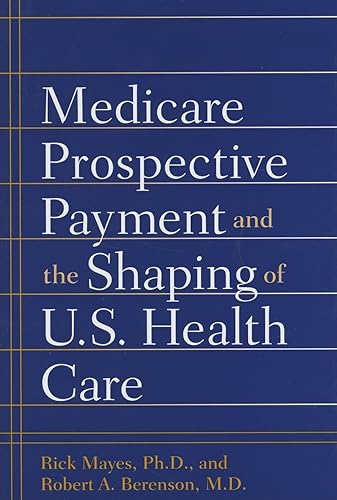
Medicare Prospective Payment and the Shaping of U.S. Health Care
Tiết kiệm 135.000 ₫
Chi tiết sản phẩm
Mô tả nội dung sách Medicare Prospective Payment and the Shaping of U.S. Health Care - Rick Mayes PhD
Thông tin sách: Medicare Prospective Payment and the Shaping of U.S. Health Care (Hardcover, 264 trang) – Johns Hopkins University Press, 2006. Ngôn ngữ: Tiếng Anh.
This is the definitive work on Medicare’s prospective payment system (PPS), which had its origins in the 1972 Social Security Amendments, was first applied to hospitals in 1983, and came to fruition with the Balanced Budget Act of 1997. Here, Rick Mayes and Robert A. Berenson, M.D., explain how Medicare’s innovative payment system triggered shifts in power away from the providers (hospitals and doctors) to the payers (government insurers and employers) and how providers have responded to encroachments on their professional and financial autonomy. They conclude with a discussion of the problems with the Medicare Modernization Act of 2003 and offer prescriptions for how policy makers can use Medicare payment policy to drive improvements in the U.S. health care system.
Mayes and Berenson draw from interviews with more than sixty-five major policy makers―including former Treasury secretary Robert Rubin, U.S. Representatives Pete Stark and Henry Waxman, former White House chief of staff Leon Panetta, and former administrators of the Health Care Financing Administration Gail Wilensky, Bruce Vladeck, Nancy-Ann DeParle, and Tom Scully―to explore how this payment system worked and its significant effects on the U.S. medical landscape in the past twenty years. They argue that, although managed care was an important agent of change in the 1990s, the private sector has not been the major health care innovator in the United States; rather, Medicare’s transition to PPS both initiated and repeatedly intensified the economic restructuring of the U.S. health care system.
From the Inside FlapThis is the definitive work on Medicare's prospective payment system (PPS), which had its origins in the 1972 Social Security Amendments, was first applied to hospitals in 1983, and came to fruition with the Balanced Budget Act of 1997. Drawing on interviews with more than sixty-five major policy makers, Rick Mayes and Robert A. Berenson explain how Medicare's innovative payment system triggered shifts in power away from the providers (hospitals and doctors) to the payers (government insurers and employers) and how providers have responded to encroachments on their professional and financial autonomy.
An exhaustively researched and provocative tale of the politics behind how doctors and hospitals are paid in America--and the roots of our health care morass.--Atul Gawande, MacArthur Fellow, author of Better: A Surgeon's Notes on Performance
Whether discussing the Social Security Amendments of 1972 or the Balanced Budget Act of 1997, Mayes and Berenson entertain readers with insider anecdotes about the ideological and practical battles government policymakers fought with powerful provider lobbies.--New England Journal of Medicine
This slender volume offers value on several dimensions. First, it is an explication of recent history that connects the dots from prospective payment to Medicare-based deficit reduction to cost shifting to managed care. By the same token, the story here serves as a bracing corrective to the mythology of market-based reform and the assumption that government's role in health is inescapably a negative one.--Health Affairs
A highly readable book that traces the history of Medicare prospective payment systems from their enactment in 1983 until today.--Journal of Health Politics, Policy and Law
Rick Mayes, Ph.D., is an associate professor of public policy at the University of Richmond and a faculty research fellow at the Petris Center on Healthcare Markets and Consumer Welfare at the UC-Berkeley School of Public Health. He is the author of Universal Coverage: The Elusive Quest for National Health Insurance and the coauthor of Medicating Children: ADHD and Pediatric Mental Health. Robert A. Berenson, M.D., is a senior fellow at the Urban Institute and coauthor of The Managed Care Blues and How to Cure Them. From 1998 to 2000, he was in charge of Medicare payment policy and managed care contracting in the Health Care Financing Administration (now the Centers for Medicare and Medicaid Services).
--Rudolf Klein, London School of Economics and London School of Hygiene "Journal of Health Politics, Policy and Law" From the Back CoverThis is the definitive work on Medicare’s prospective payment system (PPS), which had its origins in the 1972 Social Security Amendments, was first applied to hospitals in 1983, and came to fruition with the Balanced Budget Act of 1997. Drawing on interviews with more than sixty-five major policy makers, Rick Mayes and Robert A. Berenson explain how Medicare's innovative payment system triggered shifts in power away from the providers (hospitals and doctors) to the payers (government insurers and employers) and how providers have responded to encroachments on their professional and financial autonomy.
"An exhaustively researched and provocative tale of the politics behind how doctors and hospitals are paid in America―and the roots of our health care morass."―Atul Gawande, MacArthur Fellow, author of Better: A Surgeon’s Notes on Performance
"Whether discussing the Social Security Amendments of 1972 or the Balanced Budget Act of 1997, Mayes and Berenson entertain readers with insider anecdotes about the ideological and practical battles government policymakers fought with powerful provider lobbies."―New England Journal of Medicine
"This slender volume offers value on several dimensions. First, it is an explication of recent history that connects the dots from prospective payment to Medicare-based deficit reduction to cost shifting to managed care. By the same token, the story here serves as a bracing corrective to the mythology of market-based reform and the assumption that government's role in health is inescapably a negative one."―Health Affairs
"A highly readable book that traces the history of Medicare prospective payment systems from their enactment in 1983 until today."―Journal of Health Politics, Policy and Law
Rick Mayes, Ph.D., is an associate professor of public policy at the University of Richmond and a faculty research fellow at the Petris Center on Healthcare Markets and Consumer Welfare at the UC-Berkeley School of Public Health. He is the author of Universal Coverage: The Elusive Quest for National Health Insurance and the coauthor of Medicating Children: ADHD and Pediatric Mental Health. Robert A. Berenson, M.D., is a senior fellow at the Urban Institute and coauthor of The Managed Care Blues and How to Cure Them. From 1998 to 2000, he was in charge of Medicare payment policy and managed care contracting in the Health Care Financing Administration (now the Centers for Medicare and Medicaid Services).
About the Author Rick Mayes, Ph.D., is an associate professor of public policy at the University of Richmond and a faculty research fellow at the Petris Center on Healthcare Markets and Consumer Welfare at the UC-Berkeley School of Public Health. He is the author of Universal Coverage: The Elusive Quest for National Health Insurance and the coauthor of Medicating Children: ADHD and Pediatric Mental Health.Robert A. Berenson, M.D., is a senior fellow at the Urban Institute and coauthor of The Managed Care Blues and How to Cure Them. From 1998 to 2000, he was in charge of Medicare payment policy and managed care contracting in the Health Care Financing Administration (now the Centers for Medicare and Medicaid Services).
Giá bìa: 1.933.000 ₫
1.798.000 ₫
Đánh giá sản phẩm(3)
Sách cùng thể loại
Xem tất cả → 0
0MEDICAL TERMINOLOGY: A Quick & Easy Reference Book: Basics of Terminology, Anatomy, and Abbreviations
G. Chen, Stephen Leesburg
469.000 ₫
 0
0Berufliche Karrierewege nach dem Psychologiestudium: Ein Kurzüberblick für Studierende der Psychologie und Interessierte (essentials) (German Edition)
Maximilian Mendius, Simon Werther
Liên hệ
0 0
0Handbook of Juvenile Idiopathic Arthritis
Angelo Ravelli
Liên hệ
0 0
0Integrative Strategies For Cancer Patients: A Practical Resource For Managing The Side Effects Of Cancer Therapy
Elena J Ladas, Kara M Kelly
1.144.000 ₫
 0
0Against Happiness: In Praise of Melancholy
Eric G. Wilson
459.000 ₫
 0
0Manual of Dry Needling Techniques
Piyush Jain PT
Liên hệ
0 0
0Caring for Mothers and Their Babies: A Guide for Midwives (WHO Pacific Regional Office Education in Action Series, 2)
WHO Regional Office for the Western Pacific
Liên hệ
0 0
0Grief Work in Addictions Counseling
Susan R. Furr, Kathryn Hunsucker
Liên hệ
0 0
0Quiet Kids: Help Your Introverted Child Succeed in an Extroverted World
Christine Fonseca
198.000 ₫
 0
0Maternal & Child Health Nursing: Care of the Childbearing & Childrearing Family
Adele Pillitteri
1.466.000 ₫
 0
0Physico-geology: Or, a new System of Philosophical Geography. Containing a new and General Description of the Terraqueous Globe. ... The Natural ... ... With a new and Accurate set of Maps
Benjamin Martin
Liên hệ
0 0
0Explaining Criminal Behaviour: Interdisciplinary Approaches
Wouter Buikhuisen, Sarnoff A. Mednick
1.823.000 ₫